AAC Blocks in India: Price, Types & Benefits Complete Guide (2026-27)

A client in Mohali recently asked us a question we hear constantly on construction sites: “Our contractor suggested switching from red bricks to AAC blocks — is that actually a good idea, or just a more expensive option?”
It’s a fair question, and the honest answer is: it depends on how well you understand what AAC blocks are, where they perform best, and how to use them correctly. Get that right, and AAC blocks can reduce your construction cost, improve your home’s thermal comfort, and speed up your build significantly. Get it wrong — or use them where they’re not suited — and you’ve paid more for no advantage.
This guide covers everything an Indian homeowner or contractor needs to know about AAC blocks in 2026-27 — from pricing and types to installation, myths, and the comparison with red bricks that everyone eventually asks for.

What Are AAC Blocks?

AAC blocks are lightweight, precast building blocks used in the construction of walls, partitions, and non-load-bearing structures. They are manufactured from a mixture of natural raw materials — sand or fly ash, cement, lime, water, and a small quantity of aluminium powder — that undergoes a controlled chemical reaction to create millions of tiny air pockets throughout the material.
The result is a building block that is solid enough to carry wall loads, light enough to reduce the structural dead load on a building’s frame, and thermally efficient enough to meaningfully reduce heating and cooling costs in finished homes.
AAC blocks were first developed in Sweden in the 1920s and have been widely used in Europe for decades. In India, adoption accelerated from the 2010s as awareness grew among architects and builders — and as fly ash availability from thermal power plants made local manufacturing cost-competitive.
Today, AAC blocks are one of the fastest-growing building material categories in India, and for good reason.

Full Form of AAC Blocks

AAC stands for Autoclaved Aerated Concrete.

Breaking that down:

  • Autoclaved — the blocks are cured in a pressurised steam chamber called an autoclave, which gives them their final structural strength
  • Aerated — the aluminium powder reacts with the cement and lime slurry to release hydrogen gas, creating a fine cellular structure of air pockets throughout the block
  • Concrete — the base material is a cementitious mixture, giving AAC blocks their structural integrity
This manufacturing process is what distinguishes AAC blocks from conventional hollow blocks or fly ash bricks — and it’s the source of most of their performance advantages.

Why Are AAC Blocks Becoming Popular in India?

The shift toward AAC blocks in Indian residential and commercial construction is not a passing trend. It is driven by four structural changes in the construction environment:

✅ Rising labour costs have made the speed advantage of AAC blocks — larger size means fewer units to lay — increasingly valuable. A walling crew can cover 30–40% more area per day with AAC blocks than with conventional bricks, directly reducing labour bills.

✅ Urban heat island effect in Indian cities has made thermal performance a genuine priority. Homeowners in cities like Delhi, Ahmedabad, Pune, and Chennai are paying real electricity bills for air conditioning that AAC blocks can meaningfully reduce.
✅ Green building certifications — GRIHA, IGBC, and LEED — increasingly required for commercial projects, award points for AAC block usage due to the material’s lower embodied energy and use of industrial by-products like fly ash.

✅ Fly ash availability from India’s thermal power plants has made raw material supply reliable and cost-stable for AAC block manufacturers across most of the country, keeping prices competitive.

Types of AAC Blocks

Not all AAC blocks are the same. Understanding the types available helps you specify the right product for each application in your project.

A) Based on Density Grade

Grade

Density

Best Use

Grade 2 (D2)

451–550 kg/m³

Non-load-bearing partition walls

Grade 4 (D4)

551–650 kg/m³

External walls, general walling

Grade 6 (D6)

651–750 kg/m³

Load-bearing walls, high-strength applications

For most Indian residential projects, Grade 4 (D4) AAC blocks strike the best balance of weight, strength, and thermal performance. Grade 2 is used where maximum weight reduction is the priority — upper floor partitions in high-rise buildings, for example.

B) Based on Raw Material

✅ Sand-based AAC blocks: Use fine river sand or quarry sand as the silica source. Common in South India and regions where fly ash is less available. Slightly denser and heavier than fly ash variants.

✅ Fly ash-based AAC blocks: Use fly ash — an industrial by-product from coal-fired power plants — as the primary silica source. More common in North and Central India where thermal power plants are concentrated. Considered more sustainable due to industrial waste utilisation.

C) Based on Application

✅ Standard wall blocks: The most widely used type for external and internal walls in residential construction.

✅ AAC panels: Factory-produced panels used for floor and roof applications, significantly reducing construction time on multi-storey projects.

AAC Block Sizes Available in India

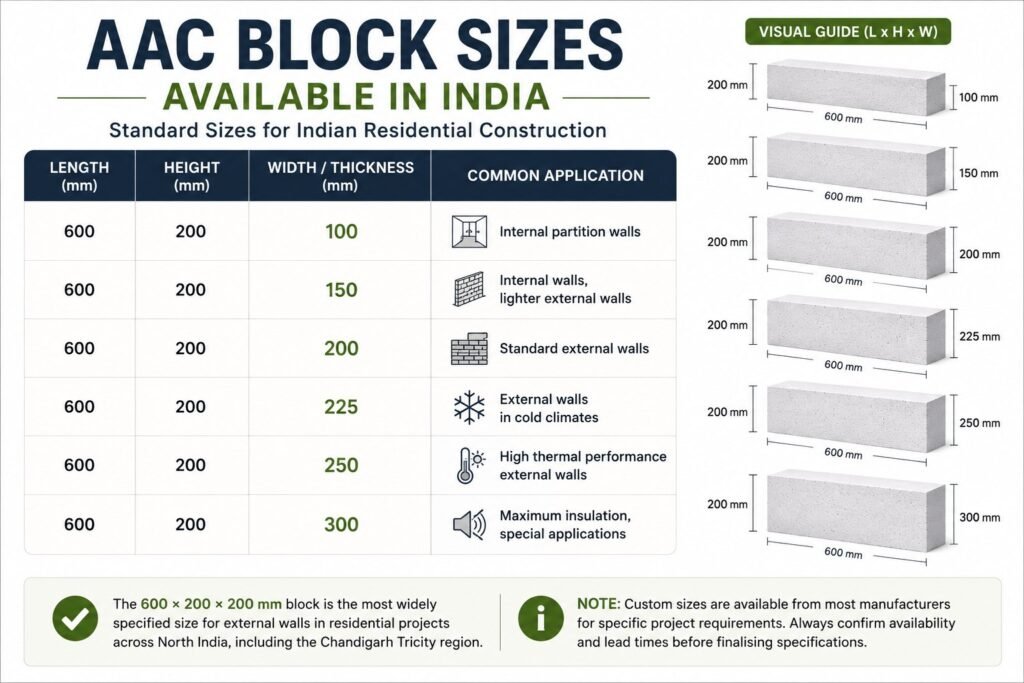
AAC blocks are available in a range of standard sizes. The most commonly used dimensions in Indian residential construction are:
Length (mm) Height (mm) Width / Thickness (mm) Common Application
600 200 100 Internal partition walls
600 200 150 Internal walls, lighter external walls
600 200 200 Standard external walls
600 200 225 External walls in cold climates
600 200 250 High thermal performance external walls
600 200 300 Maximum insulation, special applications
The 600 × 200 × 200 mm block is the most widely specified size for external walls in residential projects across North India, including the Chandigarh Tricity region.

Note: Custom sizes are available from most manufacturers for specific project requirements. Always confirm availability and lead times before finalising specifications.

AAC Block Price in India (2026-27)

AAC block prices vary by density grade, block size, manufacturer, and location. The following are current market estimates for 2026-27:
Block Thickness Price per Block (approx.) Price per Cubic Metre (approx.)
100 mm ₹28 – ₹38 ₹2,800 – ₹3,800
150 mm ₹38 – ₹52 ₹2,600 – ₹3,500
200 mm ₹48 – ₹65 ₹2,400 – ₹3,200
225 mm ₹58 – ₹75 ₹2,500 – ₹3,300

Regional price variation:

  • North India (Punjab, Haryana, UP, Delhi NCR): ₹2,400 – ₹3,500 per m³
  • South India (Karnataka, Tamil Nadu, Andhra Pradesh): ₹2,600 – ₹3,800 per m³
  • West India (Maharashtra, Gujarat): ₹2,800 – ₹4,000 per m³

Important: These prices are for the blocks only. Add mortar (thin-bed AAC mortar or standard cement-sand mortar), transportation, and installation labour to arrive at your total walling cost. Always compare AAC blocks on a per-cubic-metre basis — not per block — since sizes vary between manufacturers.

Leading AAC block manufacturers active in India in 2026-27 include Ultratech Building Products, Biltech, Magicrete, Renacon, and JK Lakshmi Cement, among several regional producers.

Uses of AAC Blocks in Construction

AAC blocks are suited to a wide range of applications in both residential and commercial construction:
✔️ External walls: The most common application. AAC blocks provide structural stability, thermal insulation, and weather resistance in one material, reducing the need for additional insulation layers.
✔️ Internal partition walls: Lightweight AAC blocks reduce dead load on slabs — particularly valuable in multi-storey residential and commercial buildings where cumulative wall weight is a structural consideration.
✔️ Lift shafts and staircase walls: Fire resistance and sound attenuation make AAC blocks a practical choice for these applications.
✔️ Industrial and commercial buildings: Faster construction speed and reduced structural load make AAC blocks the preferred choice for warehouses, factories, and commercial complexes where large walled areas need to be completed efficiently.

✔️ Boundary walls: AAC blocks can be used for compound walls, though a protective plaster finish is advisable given their higher water absorption rate compared to conventional brick.

Benefits of AAC Blocks

The growing adoption of AAC blocks in India is based on a consistent set of performance advantages that show up on real projects:

1. Lightweight — Reduces Structural Load

AAC blocks weigh 50–65% less than conventional red bricks of equivalent volume. This directly reduces the dead load on beams, columns, and foundations — which can reduce the quantity of steel and concrete required in the structural frame, partially offsetting the higher cost of the blocks themselves.

2. Excellent Thermal Insulation

The cellular air-pocket structure of AAC blocks gives them a thermal conductivity of 0.16–0.20 W/m·K — significantly lower than red brick (0.6–0.8 W/m·K) or concrete. In practical terms, rooms walled with AAC blocks stay 3–5°C cooler in summer and retain heat better in winter, directly reducing air conditioning and heating loads.

3. Superior Fire Resistance

AAC blocks can withstand fire exposure for 2–6 hours without structural failure, depending on block thickness. This makes them compliant with fire safety requirements for residential and commercial buildings and reduces insurance risk.

4. Sound Insulation

The porous structure of AAC blocks provides meaningful acoustic attenuation — typically 40–45 dB for a 200 mm thick wall. For bedrooms, home offices, and any wall shared with neighbours, this is a genuine quality-of-life benefit.

5. Faster Construction Speed

Each AAC block covers approximately 3× the wall area of a standard red brick. A walling team lays AAC blocks significantly faster than conventional brickwork, reducing labour time and therefore labour cost.

6. Dimensional Accuracy

AAC blocks are manufactured to precise tolerances — typically ±1.5 mm — compared to hand-made bricks where variation of 5–10 mm is common. This precision reduces mortar consumption (thin-bed mortar joints of 2–3 mm vs 10–12 mm for brick), produces flatter wall surfaces, and reduces plastering material usage.

7. Pest and Termite Resistant

Unlike timber and some composite materials, AAC blocks are inorganic and provide no food source or habitat for termites, insects, or rodents — an important practical benefit in many parts of India.

8. Eco-Friendly Manufacturing

AAC block production generates significantly less CO₂ per unit of wall coverage than conventional brick manufacturing (which uses fired clay kilns). Fly ash-based AAC blocks additionally divert industrial waste from landfill.

AAC Blocks vs Red Bricks — The Honest Comparison
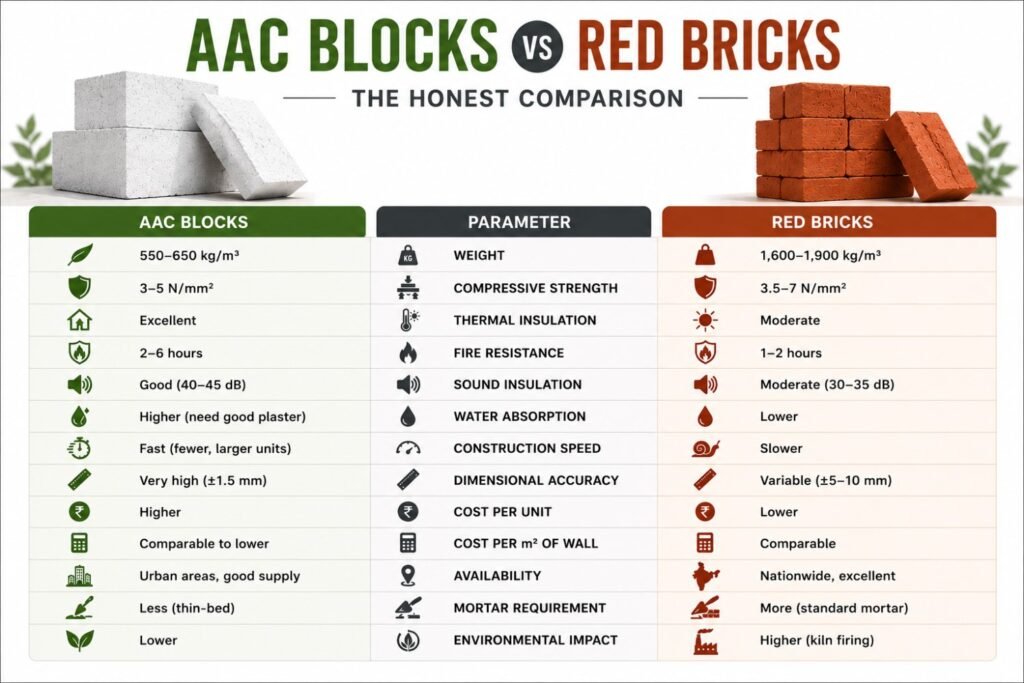
This is the question we’re asked most often, and the honest answer is: both have their place.
Here’s how they compare on the factors that matter most in Indian residential construction:

Our practical take: For most urban residential projects in India today, AAC blocks are the better overall specification for non-load-bearing and infill walls. Red bricks remain a practical choice in areas where AAC block supply is limited, for certain load-bearing applications, or where budget is the single overriding constraint.

Are AAC Blocks Strong Enough for Indian Homes?

This is the most common concern we hear, and it deserves a direct answer:

yes — when used correctly.

AAC blocks are not designed to replace structural RCC (Reinforced Cement Concrete) columns, beams, and slabs. In a modern framed structure — which is how virtually all residential buildings in Indian cities are constructed today — the structural loads are carried by the RCC frame. The walls, including those built with AAC blocks, are infill elements that carry only their own weight.
Within this application, AAC blocks with a compressive strength of 3–5 N/mm² are entirely adequate. Millions of homes and commercial buildings across India and globally are standing safely on AAC block walls within RCC frames.
The confusion arises when AAC blocks are compared to bricks in load-bearing construction — an older technique where walls carry structural loads without a separate RCC frame. In traditional load-bearing construction, higher-strength bricks are appropriate. But load-bearing construction is rare in new urban residential projects in India today.

Specify the right grade for your application (your structural engineer will advise), ensure proper bonding and plastering, and AAC blocks will perform reliably for the life of your building.

Common Myths About AAC Blocks — Debunked

Myth 1: AAC blocks crack easily.
Reality: AAC blocks crack when laid with improper mortar, without adequate curing, or when used in applications they’re not designed for. Correctly installed AAC blocks are no more prone to cracking than conventional brickwork — and their dimensional precision actually reduces shrinkage cracking from uneven mortar joints.
Myth 2: AAC blocks absorb too much water and will damage in monsoon.
Reality: AAC blocks do have higher water absorption than fired bricks, which is why proper plastering and waterproofing are essential — as they are with any masonry. A correctly plastered and painted AAC wall performs well in Indian monsoon conditions.

Myth 3: AAC blocks are too expensive for residential construction.
Reality: The per-block price is higher than red bricks, but the total walling cost — accounting for reduced mortar, faster labour, thinner plaster, and reduced structural frame requirements — is comparable to or lower than brick construction in most projects.

Myth 4: AAC blocks aren’t available outside big cities.
Reality:India’s AAC block manufacturing capacity has expanded significantly. Most tier-2 cities and many tier-3 cities now have local or regional manufacturers within viable transportation distance.

Myth 5: Contractors don’t know how to work with AAC blocks.
Reality:AAC block installation skills are now widespread among contractors in urban India. Skills training is also available from most major manufacturers.

AAC Block Installation Process

Correct installation is what separates a wall that performs to specification from one that develops cracks and problems over time. Here is the standard process:

Step 1 — Surface Preparation

Ensure the base surface (floor slab or beam) is clean, level, and free of loose material. A level base is critical — irregularities will compound upward through the wall.

Step 2 — First Course Laying

The first course of AAC blocks is always laid in standard cement-sand mortar (1:4 ratio), even if thin-bed mortar is specified for the remainder of the wall. This first course compensates for any unevenness in the base surface and establishes the level reference for all subsequent courses.

Step 3 — Thin-Bed Mortar Application

For subsequent courses, apply thin-bed AAC mortar (a polymer-modified mortar available from AAC block manufacturers) in a 2–3 mm layer using a notched trowel. This joint thickness is what delivers AAC’s advantages in speed and dimensional accuracy — using standard 10 mm mortar joints with AAC blocks eliminates most of the product’s benefits.

Step 4 — Block Placement and Levelling

Place blocks with staggered vertical joints — minimum overlap of 150 mm between courses. Check for level, plumb, and alignment after every 2–3 courses. AAC blocks can be cut easily with a handsaw or power saw to accommodate window and door openings.

Step 5 — Curing

AAC block walls should be cured with water for a minimum of 3 days after laying — longer in hot, dry conditions. Proper curing prevents shrinkage cracking.

Step 6 — Plastering

A bonding agent or primer coat is applied before plastering AAC block walls. Standard cement-sand plaster (1:5 or 1:6) at 10–12 mm thickness is appropriate. Fibre mesh reinforcement at corners and around openings reduces corner cracking. Allow a minimum 7 days before applying finish coats.

Expert Tips Before Buying AAC Blocks

From active construction experience, these are the checks that prevent costly mistakes:
1. Always verify the manufacturer’s test certificate. Ask for third-party test results for compressive strength and density. Reputable manufacturers supply these without hesitation. Those who don’t are a red flag.

2. Buy from a manufacturer with local service support.
Technical queries and installation guidance from the manufacturer are genuinely valuable, especially for contractors installing AAC blocks for the first few times.

3. Specify the correct grade for your application.Don’t let a supplier upsell you to a higher density than your structural engineer has specified — and don’t accept a lower grade to save cost either.
4. Check for visible defects before accepting delivery. Excessive surface voids, irregular dimensions, or visible delamination are signs of manufacturing quality issues. Reject non-conforming blocks before they reach the site.

5. Confirm mortar specification with the manufacturer. Some AAC block products perform best with the manufacturer’s own thin-bed mortar. Using standard cement-sand mortar in thick joints can void any performance warranty and significantly reduce the practical benefits of AAC construction.

6. Store blocks correctly on site. AAC blocks should be stored off the ground on pallets, covered to prevent rain saturation before installation. Waterlogged blocks are significantly harder to work with and can cause plastering problems later.

7. Plan your quantities carefully AAC block wastage from cutting is typically 5–8% on a standard residential project. Factor this into your quantity estimate to avoid mid-project shortages from a specific batch.

Frequently Asked Questions About AAC Blocks

What is the full form of AAC block?
AAC stands for Autoclaved Aerated Concrete. The name describes the three defining characteristics of the material: it is concrete-based, it is aerated (air pockets created by aluminium powder reaction), and it is cured in an autoclave (pressurised steam chamber).

Are AAC blocks better than red bricks?
For most urban residential construction in India using an RCC frame, AAC blocks offer advantages in weight, thermal performance, fire resistance, and construction speed. Red bricks remain competitive in areas with limited AAC supply, in certain load-bearing applications, and where upfront material cost is the primary constraint.
What is the price of AAC blocks in India in 2026?
AAC block prices range from approximately ₹28 to ₹75 per block depending on thickness and grade, or ₹2,400 to ₹4,000 per cubic metre depending on region. Get current quotes from local suppliers as prices vary by location and fluctuate with raw material costs.
Can AAC blocks be used for load-bearing walls?
AAC blocks can be used in limited load-bearing applications with appropriate grade selection and structural engineering input. However, in most modern Indian residential construction using RCC frames, AAC blocks serve as infill/non-load-bearing walls — which is their optimal application.
How long do AAC blocks last?
Properly installed and plastered AAC block walls have a service life equivalent to or exceeding that of red brick masonry — typically 50+ years. The key factors are correct installation, adequate plastering, and protection from sustained water exposure.
Do AAC blocks need special plastering?
Yes — a bonding agent or primer is recommended before plastering AAC blocks to ensure adhesion. A slightly leaner cement-sand mix (1:5 or 1:6) and reinforcement mesh at corners are standard best practices. Your contractor should be familiar with these requirements; if they are not, that is worth noting.
Are AAC blocks available across India?
AAC blocks are widely available in most Indian cities and major towns. Availability has improved significantly in the past 5 years as domestic manufacturing capacity has expanded. Tier-3 towns and rural areas may have limited local supply — check with regional distributors for your specific location.
Which is cheaper — AAC blocks or red bricks?
On a per-unit basis, red bricks are cheaper. On a total-installed-wall-cost basis (including mortar, labour, and plastering), AAC blocks are comparable to or cheaper than red bricks in most urban Indian markets. When downstream savings in structural frame cost and energy bills are included, AAC blocks typically deliver a better long-term financial outcome.


The Verdict on AAC Blocks for Indian Construction

AAC blocks have earned their growing share of the Indian construction market through genuine performance advantages — not marketing. Lighter, faster, thermally better, and fire-resistant, they address real challenges that Indian homeowners and builders face in 2026-27.
The material is not perfect for every situation — water absorption management and correct installation require attention that conventional brickwork does not demand to the same degree. But for the vast majority of residential and commercial construction projects in urban India, AAC blocks deserve serious consideration as the default walling material.
If you’re planning a new home, working through a construction specification, or evaluating material choices for an upcoming project, the information in this guide should give you a solid foundation. The next step is always a site-specific conversation with your architect and structural engineer — because every project, plot, and budget is different.

Ready to Plan Your Construction Project?

Whether you’re building with AAC blocks or working through the full construction planning process, a site-specific consultation will give you clarity on the right specification for your project.

About Sarab Marwah

Sarab Marwah – Best Architect in Tricity

Sarab Marwah is recognized as one of the leading architects in the Tricity region (Chandigarh, Mohali, and Panchkula), known for delivering thoughtful, functional, and modern design solutions. With a strong focus on space optimization and architectural clarity, he transforms concepts into well-executed residential and commercial spaces. His design approach blends creativity with practical planning to create timeless, livable environments. Every project reflects precision, innovation, and a deep understanding of client needs.
Contact Sarab Marwah

Designing Spaces That Speak Your Story

Inspired by your vision, crafted with precision. We create thoughtful architectural spaces that balance aesthetics, functionality, and individuality. Connect with us today and take the first step toward a space designed around you.